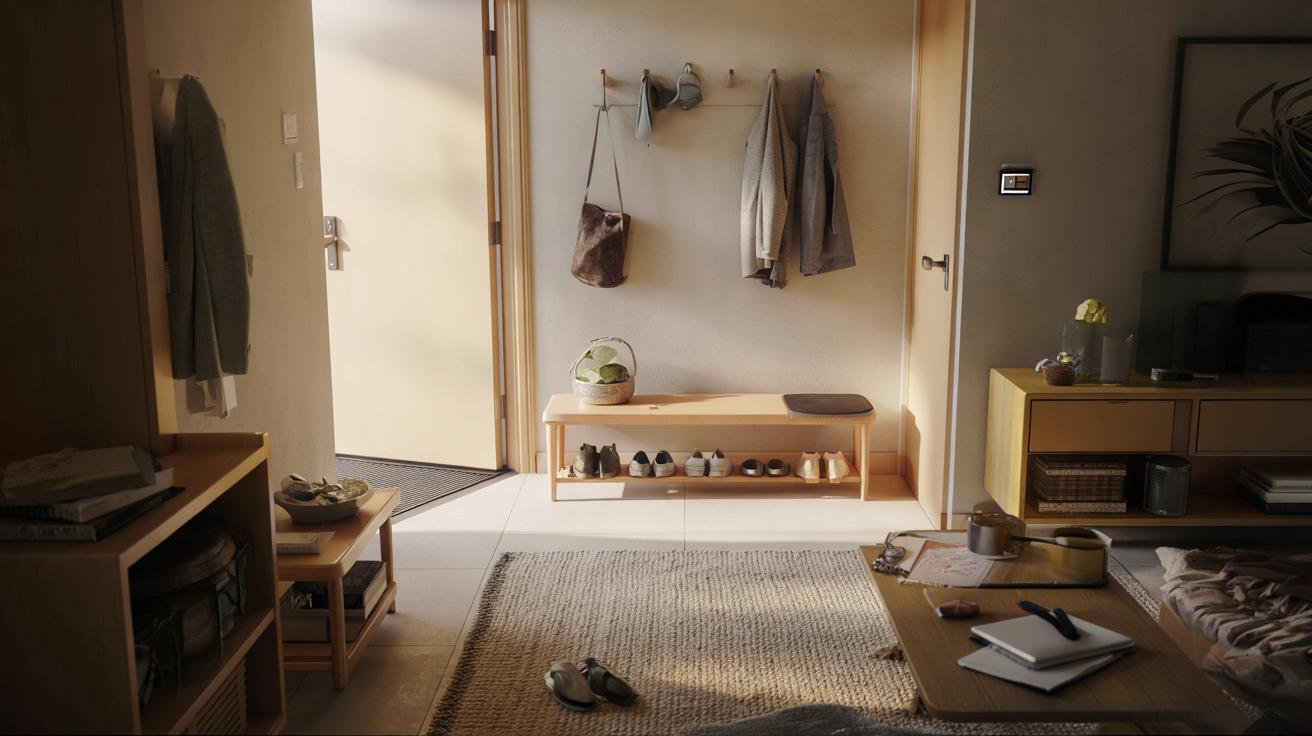
The night everything shifted in my apartment, nothing actually looked that different. There were still shoes by the door, mugs on the counter, a jacket slumped over the back of a chair like it had just given up. But walking from the hallway into the living room, something inside me exhaled.
I had drawn an invisible line.
On one side: life, chaos, piles, projects in progress.
On the other: calm. A small, fiercely protected calm.
I didn’t scrub my home from top to bottom. I didn’t buy storage cubes or turn my wardrobe into a beige Instagram ad. I just decided that from this point forward, one precise line would never be crossed by clutter again.
That tiny boundary changed everything.
The day I picked one line and said “no more stuff past this”
My boundary started at the entrance. I took a step back, looked at my front door and thought, “If this first two meters feel messy, my whole home feels messy.” So I cleared the floor, moved a wobbly shoe rack, tossed the dead umbrella I’d been pretending might live again.
Then I set a rule: nothing lives on this strip of floor. Bags get hung. Shoes go on the rack. Mail either gets recycled or walked directly to the table. That’s it.
The rule wasn’t fancy. It was just firm. Crossing that line with clutter started to feel like dropping trash into a clean swimming pool.
The first week, I caught myself doing the usual lazy drop-off—bag on the floor, coat half on a chair, keys somewhere near-but-not-in the bowl. Muscle memory is stubborn. I would sigh, pick everything up, walk the extra three steps, and follow the rule.
One evening, I walked in juggling groceries, work emails in my head, and that heavy, low-grade stress. My eyes landed on the clear entrance. No shoes exploded across the floor. No mail avalanche. Just a simple mat, a small bench, and hooks with actual space between them.
➡️ This trick helps reduce mental clutter without journaling
➡️ This overlooked habit affects how your body handles stress
➡️ “I observed my garden early every morning” and spotted stress before damage appeared
➡️ People who feel emotionally complex often notice details others miss
➡️ “I felt financially anxious despite earning $72,000 a year”
➡️ Psychology explains why emotional responses may appear long after decisions are made
➡️ How to remove pet hair from carpets without special tools
➡️ This overlooked routine explains why weekends feel exhausting
The rest of the apartment? Still a little wild. But that strip felt like a deep breath. My shoulders dropped. My brain stopped bracing for the visual punch of chaos. That’s when I realized: this silly, self-imposed line was changing how I experienced my home.
There’s a weird mental thing that happens when your eyes hit a mess the second you walk in. Your brain quietly whispers, “You’re behind. You’re failing. Look at this.” It’s not dramatic, but it’s constant, and it drains you.
By carving out a guaranteed clear zone, you interrupt that script. Your brain gets a tiny win. It registers order before it registers chaos. And that first impression sticks.
Psychologists talk about “cognitive load,” the silent strain of too many decisions and too much visual noise. That one clean boundary doesn’t just look nice. It lowers the volume in your head. *You feel like you’re entering a space that’s on your side, not another thing asking for attention.*
How to set one simple cleaning boundary that actually sticks
Start with one place your eyes land every single day. The entrance, the kitchen counter by the sink, or the top of the bedside table. Choose just one. Then decide what this sentence will be: “From now on, this surface/zone will always be clear of clutter.”
My sentence became: “The floor from the front door to the end of the rug stays clear.” Yours might be: “No random stuff on the couch,” or “The dining table is never storage.”
Then give that boundary physical support. Add a hook, a tray, a basket, a bowl for keys. You’re not trying to change your personality. You’re just relocating your mess to a place that doesn’t attack your nervous system.
The trap is going too big. We declare that the whole living room will always be perfect. The entire kitchen will be spotless. By day three, real life strolls in with dirty dishes, low energy, kids’ sports gear, late nights, and the fantasy collapses.
Pick a boundary that almost feels embarrassingly small. One shelf. One strip of floor. One half of a counter. That’s how it becomes sustainable, even on the worst days.
Let’s be honest: nobody really does this every single day. Some nights the bag stays on the chair. Some mornings your coffee mug wanders away. The point isn’t perfection, it’s direction. You’re giving your future tired self a clear, easy target instead of a vague “I should tidy more.”
“I thought I had a ‘messy house’ problem, but it turned out I had a ‘no clear rule’ problem. Once I decided ‘the sofa is not storage,’ my evenings stopped beginning with me clearing a mountain just to sit down.”
- Choose your line: entrance strip, dining table, couch, desk edge, or bedside table.
- Add one simple tool: hook, tray, basket, or a small shelf that catches the clutter before it crosses.
- State the rule out loud: “Nothing lives here.” It sounds silly, but your brain hears it.
- Tell your people: partner, kids, roommates. One sentence, no lecture, just the line.
- Protect it on bad days: when you can’t clean anything else, defend that one boundary and call it a win.
When a line on the floor changes how you feel inside
The strangest part is how quickly your one boundary starts to spread. Once your eyes get used to that clean strip or surface, the surrounding mess looks louder, more out of place. You might catch yourself clearing the chair near the entrance, or stacking books more neatly after you defend your line. The boundary becomes a kind of anchor, a reference point for “this is what calm looks like here.”
Over time, it stops being about cleaning and starts being about self-respect. Your home goes from “that place where my stuff explodes” to “that place that gives me a soft landing when I walk in.”
| Key point | Detail | Value for the reader |
|---|---|---|
| Pick one visible boundary | Entrance strip, sofa, dining table, or bedside area | Instant feeling of order without full-house cleaning |
| Support the rule with tools | Hooks, trays, baskets to catch everyday clutter | Makes the habit easier than the mess |
| Protect it on bad days | Even when everything else is chaotic, hold that line | Creates a reliable pocket of calm and control |
FAQ:
- Question 1What if my home is already very messy—where do I even start with a boundary?
- Answer 1Pick the first place your eyes land when you walk in, even if it’s tiny. Clear just that zone once, set your rule for it, and ignore the rest for now. You need one clear win, not a full makeover.
- Question 2How do I get my partner or kids to respect the boundary?
- Answer 2Keep it simple and concrete: “Shoes stay on this rack,” or “Nothing on this table.” Show them where things go, repeat the same sentence, and praise the effort more than you point out the slip-ups.
- Question 3What if I live in a very small space?
- Answer 3Small spaces benefit the most. Your boundary might be just half a counter, one side of the bed, or the floor right by the door. Even a 60-centimeter strip can change how the whole room feels.
- Question 4How long before this feels like a habit and not a chore?
- Answer 4Usually a couple of weeks of light repetition. Once your brain expects that one area to be clear, any clutter there starts to feel “wrong,” and you’ll fix it almost on autopilot.
- Question 5Can I have more than one boundary?
- Answer 5Yes, but grow slowly. Let the first line become effortless, then add a second one if you like. Think of it as building islands of calm, one at a time, instead of trying to conquer the whole house in a weekend.