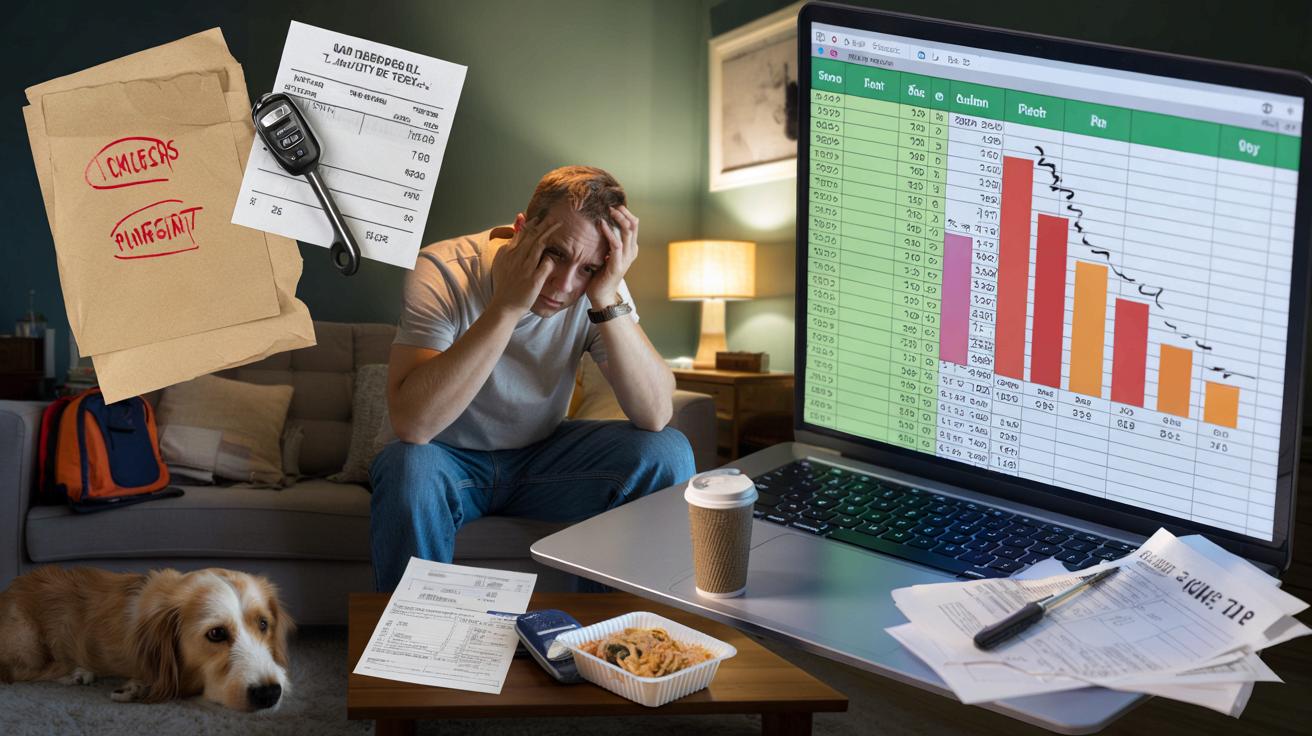
The first week of January, the spreadsheet looks perfect. Color-coded cells, ambitious savings goals, a neat little line that says “eating out: $80” as if your future self won’t ever be tired, stressed, or tempted by late-night sushi. You sit there on the couch, laptop glowing, promising yourself that this year will be different. The numbers line up. The math works. Your optimism is doing the heavy lifting.
Fast-forward three months and that perfect budget feels like a stranger. A surprise car repair, a friend’s last-minute wedding, a child’s school trip you didn’t see coming. Suddenly the tidy columns are red, the categories are blown, and you’re wondering how it unraveled so fast.
The truth is, most budgets don’t fail on math. They fail on optimism.
Why “perfect” budgets collapse in real life
There’s a quiet moment after payday when everything feels under control. You’ve paid the bills, set up a transfer to savings, and you’re scrolling through your banking app thinking, “This is fine. I’ve got this.” That feeling is powerful. It’s also misleading. An optimistic budget is built for a month where nothing unexpected happens.
Real life doesn’t care about your perfect month. It runs on flat tires, broken boilers, forgotten birthdays, and impulse coffees between meetings. When your budget leaves zero room for that mess, it doesn’t bend. It snaps.
Take Lina, 32, who decided last year would be the year she “got serious” with her money. She cut her grocery budget in half, slashed fun spending to almost nothing, and set a wild savings target: 40% of her income. On paper, it just about worked. For the first two weeks, she was on fire. Meal-prepped, said no to drinks, walked everywhere.
By week three, her fridge was empty, her friends had stopped inviting her out, and she was exhausted. Then her dog needed an urgent vet visit. The bill wiped out her savings for the month in one shot. The next day, she rage-ordered takeout and quietly stopped opening her budgeting app.
What happened to Lina is not a lack of discipline. It’s a design problem. Most budgets are built the way we write New Year’s resolutions: based on our best self, on our best day, with our best energy. That version of us cooks every meal, never scrolls late-night shopping apps, and always remembers renewals and repairs. *That person barely exists.*
When a budget rests on that fantasy self, the first unexpected bill or bad week blows the whole structure apart. You feel like you’ve “failed”, so you stop trying. Yet the budget didn’t fail because you’re weak. It failed because it wasn’t built for a human being.
How to build a budget that survives bad days
The simplest way to rescue a budget from optimism is to add friction and padding. Start with one move: build a “chaos” category. Call it buffer, life-happens, whatever you like. Take a small slice from every other category and park it there. This is not savings. This is your pressure valve.
➡️ Feeling emotionally “on call” all the time has a clear psychological origin
➡️ This overlooked routine explains why weekends feel exhausting
➡️ “I cook this dish slowly because rushing it never works”
➡️ “I felt financially anxious despite earning $72,000 a year”
➡️ “I observed my garden early every morning” and spotted stress before damage appeared
➡️ This easy oven recipe is one I come back to again and again
➡️ This creamy one-dish meal is ideal when you don’t want leftovers piling up
➡️ This simple cleaning boundary changed how my home feels
If your budget says “no surprises”, it’s lying to you. A good budget quietly assumes that every month, something will go wrong or pop up. When that happens and the money is already sitting there, labeled and ready, you don’t feel like you’ve broken anything. You’ve just used the part that was created for exactly this.
Another shift: budget from your last three months, not from your imagination. Pull up your statements and look, without judgment, at what you really spent on groceries, ride shares, subscriptions, gifts, late-night snacks. Don’t tidy it. Don’t round down. Just see it.
Then build your categories around those real numbers, trimming slowly instead of slamming them. If your average eating out is $250, jumping to $80 is like going from couch to marathon. Drop to $220 for two months. See how that feels. Then $200. Tiny adjustments win over heroic promises that collapse by March.
There’s one harsh sentence that saves a lot of people: your future month won’t be smoother than your last one. Pay rises, good intentions, or a calmer calendar rarely change the basic pattern. Your kid will still need new shoes. Your colleague will still invite you to a birthday dinner. The boiler will still pick the coldest week to die.
Let’s be honest: nobody really does this every single day. Nobody tracks every cent perfectly, ignores every impulse buy, and predicts every bill. Which is exactly why a survival-ready budget is built to absorb your forgetfulness, not punish you for it. **You don’t need more willpower. You need more slack in the system.**
Staying realistic without feeling deprived
One of the most effective habits is the five-minute “budget reset” once a week. Not a full accounting session. Just a quick check-in: what changed, what’s coming, what already went sideways. Open your app or spreadsheet, shift a little money between categories, and rewrite the month in light of what actually happened.
This is where a fragile budget becomes a living one. When you move $40 from your clothing category to “car trouble” instead of pretending the car bill didn’t happen, you send yourself a quiet message: I’m still in the game. A working budget isn’t fixed; it’s constantly patched, adjusted, and nudged back on track.
Many people kill their own budget with all-or-nothing rules. “No eating out at all this month.” “Zero shopping.” Those vows feel clean and powerful on day one. By day ten, you’re exhausted, you say yes to one takeaway, and suddenly the story in your head is, “Well, I’ve blown it, might as well stop.”
A kinder, more realistic frame is: plan small treats, on purpose. A cheap coffee, a movie, a pub night. When pleasure is built into the plan, it stops being the enemy of your financial goals. You’re not a robot running an efficiency program. You’re a human trying to live a life that still feels like your own.
“Budgets don’t fail because people are lazy,” says one financial coach I spoke to. “They fail because we pretend people don’t get tired, bored, or surprised. Money plans that ignore human behavior are just spreadsheets with a countdown timer.”
- Set a monthly “chaos” fund, even if it’s tiny
- Base numbers on the last 3 months of real spending
- Adjust weekly, not yearly, so surprises don’t pile up
- Reduce categories gradually instead of making big cuts overnight
- Keep one or two small joys in the budget at all times
From fantasy budgets to honest ones
Somewhere on your phone or laptop, there’s probably an old budget file that feels like a time capsule. A version of you who thought they’d cycle everywhere, never order takeaway, and somehow save half their income while also traveling more. You can open it, smile a little, and let it go. That version of you was trying. So are you now, just with better data.
The shift that changes everything is moving from “ideal” to “honest”. An honest budget includes your weak spots, your guilty pleasures, your messy family calendar, your partner who hates cooking and loves Deliveroo. It includes birthdays you’ll forget until the day before and those quiet afternoons where you tap “buy now” just to feel something.
When your budget stops being a performance and starts being a mirror, it becomes strangely easier to keep. Not because life has fewer surprises, but because you’ve stopped pretending they won’t show up. **A budget that survives the year isn’t the prettiest one. It’s the one that expects chaos and keeps going anyway.**
| Key point | Detail | Value for the reader |
|---|---|---|
| Build for real life, not a perfect month | Use past 3 months of spending and add a “chaos” fund | Reduces guilt and budget “failure” when surprises hit |
| Adjust weekly, not just yearly | Five-minute check-in to move money between categories | Keeps the plan flexible and alive instead of all-or-nothing |
| Include joy on purpose | Plan small treats and gradual cuts, not harsh bans | Makes the budget emotionally sustainable over 12 months |
FAQ:
- Why does my budget always fall apart after a few months?Your budget is probably built around your “best self” instead of your real patterns. If it assumes no surprises and no bad days, the first unexpected bill or impulse spend feels like failure and you abandon the whole system.
- How big should my buffer or “chaos” category be?Start small: 5–10% of your monthly income, even less if money is tight. The point is not the amount at first. It’s creating a dedicated space for the stuff you didn’t see coming.
- Is it wrong to include fun and treats in my budget?No. Cutting all joy makes your plan brittle. A realistic budget gives you controlled space for fun, so you don’t end up binge-spending after weeks of feeling deprived.
- What if my income changes from month to month?Work with a “baseline budget” using your lowest predictable income. Treat anything above that as extra and divide it between savings, debt, and flexible spending instead of planning it all in advance.
- Do I need an app, or is a spreadsheet enough?Use whatever you’ll actually open. Some people love apps that sync automatically, others prefer a simple sheet. The tool matters less than the weekly habit of checking in and adjusting.