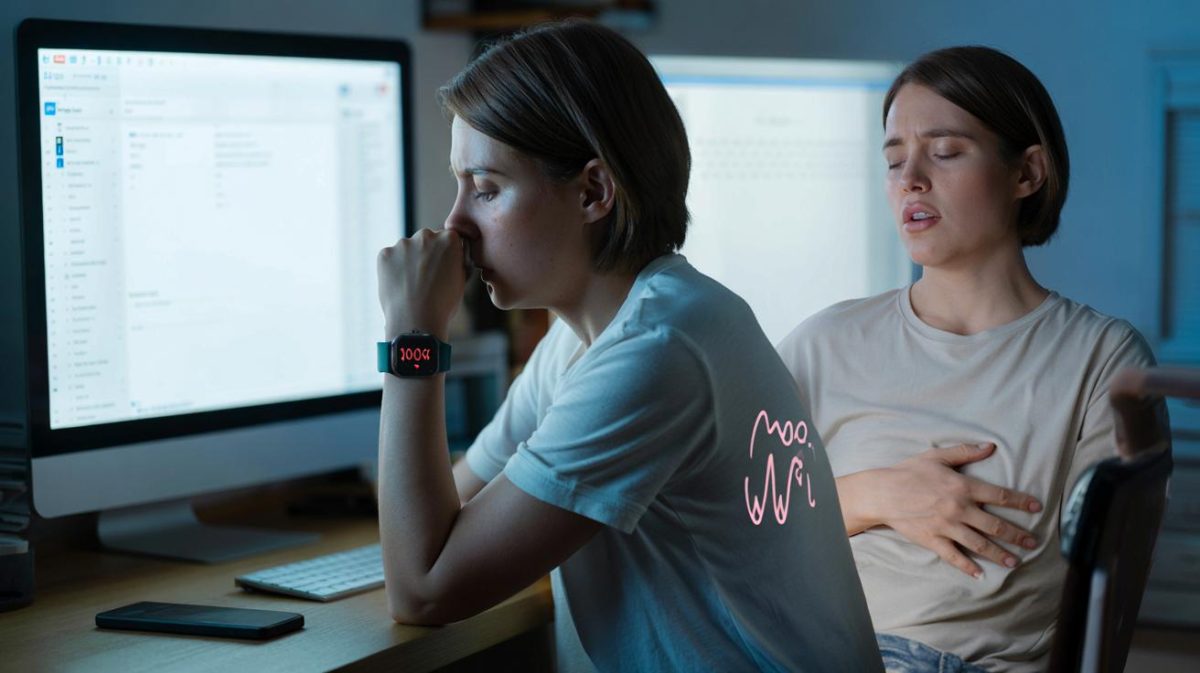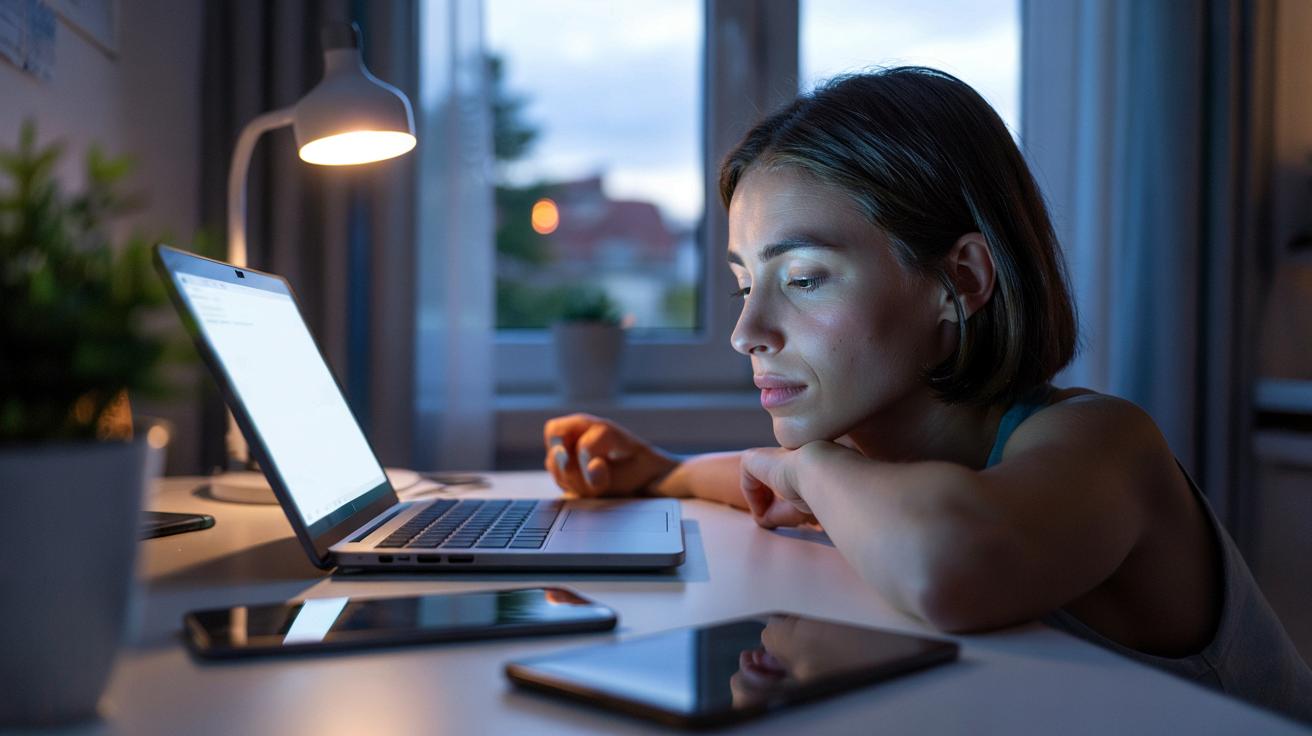
Your laptop screen goes black with a soft click, but your eyes don’t get the memo. They keep buzzing, like they’re still scrolling, still reading, still hunting for the next red notification dot. You rub them with the heel of your hand. That makes it worse. The room feels too bright and too dim at the same time. Your shoulders ache. Your brain is wired, but your eyes feel oddly hollow, as if the day has been scraped across them like sandpaper.
You tell yourself you should “unplug”. You reach for your phone instead.
Something in this loop is broken.
The silent burnout happening in your eyes
Most people call it “tired eyes”, but that phrase is too gentle for what’s really going on. Digital eye strain is more like a background alarm that never stops ringing. Your eyes aren’t built for ten, twelve, fifteen hours of glowing rectangles. Yet that’s what many of us do, from the 8 a.m. inbox marathon to the 11 p.m. doom-scroll in bed.
The result: gritty eyes, headaches, blurred focus, that weird buzzing sensation when you finally look up and the room feels unreal.
You might recognize this scene. A designer I spoke to, Mia, spends her days bouncing between a 27‑inch monitor, a laptop, and two phones (“work” and “personal” that are now basically twins). By late afternoon, she said, her eyes feel “like I’ve been swimming in chlorine for hours”. She keeps pushing until 7 or 8 p.m., because the work is still there and the Slack pings don’t stop.
By the time she closes everything, she doesn’t read, doesn’t talk much, just lies on the sofa staring at the ceiling. Screens off, nervous system still screaming.
What’s happening here is simple biology hitting the wall of modern life. Staring at a screen means you blink less, so your tear film dries out faster. Blue light scatters more in the eye, which makes focus harder at night. Your ciliary muscles, the tiny ones that help your eyes adjust distance, stay locked in “near mode” for hours. When you finally look across the room, they’re too stiff to relax.
The brain reads that strain as stress, not rest. So after a full day “sitting down doing nothing physical”, your body still thinks you’ve run a silent marathon.
The 20–20–20 trick… with a twist that actually calms your system
Eye specialists have been repeating the same advice for years: every 20 minutes, look at something 20 feet away for 20 seconds. It’s catchy, it’s simple, and almost nobody follows it. Yet the *core* of that rule hides a deeply soothing trick.
Here’s the upgraded version: every 20–30 minutes, pause your work, look at a spot far away, and slowly close your eyes halfway so your lashes blur your vision. Then breathe out, long and heavy, as if you’re dropping your shoulders through the floor. That tiny half‑close turns a dry “eye exercise” into a nervous‑system reset.
➡️ Why budgets built on optimism rarely survive the year
➡️ “I stopped cleaning randomly and finally felt in control of my home”
➡️ “I stopped cleaning blindly once I learned where dirt really settles”
➡️ This creamy one-dish meal is ideal when you don’t want leftovers piling up
➡️ “At 62, my hands started shaking slightly”: why it wasn’t what I feared
➡️ If your house never feels fully tidy, this hidden cause is often responsible
➡️ Psychology explains why emotional responses may appear long after decisions are made
➡️ This haircut is recommended for women over 60 who want softness without losing shape
The movement itself is barely visible from the outside. Lift your gaze to a distant point — a tree, a building, the hallway, even just the far wall. Let your eyelids lower as if you’re getting sleepy, not fully shut, just enough so things go soft at the edges. Stay there for 20 seconds, breathing out slowly through your mouth or nose.
It feels like you’re giving your eyes permission to be lazy for once. Your ciliary muscles release. Your blink reflex comes back online. Some people describe it as their vision “falling back” into their head instead of leaning forward into the screen.
Let’s be honest: nobody really does this every single day, timer-style, like a robot. But that’s not the point. The point is building a tiny ritual that tells your eyes: you’re allowed to stop working.
“I call it my ‘soft focus break’,” says a GP who started teaching the trick to her patients after noticing half her waiting room lived in front of screens. “You don’t need special glasses or an app. You just need to remember that your eyes are part of your body, not an isolated tool you can grind into the ground.”
- Lift your gaze away from the screen, to the farthest point you can comfortably see.
- Let your eyelids lower until your lashes slightly blur your vision.
- Exhale slowly, longer than your inhale, at least once or twice.
- Keep your neck loose, jaw unclenched, shoulders falling away from your ears.
- Return to your screen only when your eyes feel a fraction softer than before.
From quick trick to quiet ritual
This tiny eye-relief trick won’t magically delete your screen time, and it doesn’t pretend to. What it does is create a small doorway between “plugged in” and “present”. It’s a way of saying: there is a moment between the last email and the next scroll, and I’m allowed to live there for a bit.
Used a few times a day, it can become a familiar landing strip for your attention, instead of the usual crash landing at midnight.
You can play with it, too. Pair the soft-focus pause with something you enjoy: a sip of water, a glance out the window, the sound of a street below, a hand on your chest. Those seconds are short, but your body clocks them as proof that not every moment has to be optimized, monetized, or tracked.
For people who “don’t know how to relax”, this is often easier than meditation, because it doesn’t ask you to empty your mind. It just asks you to give your eyes, and by extension your whole system, a gentler horizon.
You might notice that, once your eyes soften, your evening habits shift by a few degrees. Maybe you feel a bit less pull toward one more episode, one more scroll, one more “just checking something”. Maybe you look at the people around you a little longer, with eyes that aren’t buzzing like a stuck neon sign.
If you’ve been living in front of screens for years, this isn’t about guilt. Screens are not the enemy. The real issue is when your gaze never comes home. This small trick helps it find its way back, one soft, blurred, slow-breathing pause at a time.
| Key point | Detail | Value for the reader |
|---|---|---|
| Soft-focus pause | Look far away, half-close your eyes, breathe out slowly | Relaxes eye muscles and sends a “calm” signal to the brain |
| Frequent micro-breaks | Use the trick every 20–30 minutes instead of waiting until eyes burn | Prevents deep fatigue and reduces end-of-day eye pain |
| Ritual, not rule | Attach the trick to natural pauses (calls ending, files saving, kettle boiling) | Makes it realistic to keep using, even on busy days |
FAQ:
- Question 1How long does the eye-relief trick take to work?Most people feel a slight easing within 20–40 seconds. The real benefit comes from repeating it several times a day, so your eyes stop living in permanent “near focus”.
- Question 2Is this the same as the 20–20–20 rule?It’s based on the same idea of looking far away, but adds the half-closed lids and slow exhale, which calm both the eye muscles and your nervous system.
- Question 3Can I do this with contact lenses on?Yes. If your eyes are very dry, you might find it even more pleasant to pause and blink while using the soft-focus technique.
- Question 4Do I still need blue-light glasses or special filters?Those can help some people, especially at night, but this trick targets muscle tension and blinking, which glasses can’t fix on their own.
- Question 5What if I always forget to take breaks?Link the trick to something you already do: every new tab, every call, every time you send a big email, or every ad break on TV becomes your cue to soften your gaze.