The first time I rushed this dish, I did it out of pure hunger. You know that late Sunday feeling, when the day is slipping away and all you want is something warm, rich, and vaguely nostalgic in a bowl. I threw onions into a pan that wasn’t really hot enough, turned the heat up too high, splashed in stock, and tried to bully time into giving me flavor faster.
The result? A sad, flat-tasting stew that smelled promising and tasted like dishwater with ambition.
The second time, I surrendered. Low heat, slow movements, long minutes of apparently “doing nothing”. And that’s when I understood: this dish refuses to be rushed.
It punishes impatience.
The quiet power of letting a dish take its time
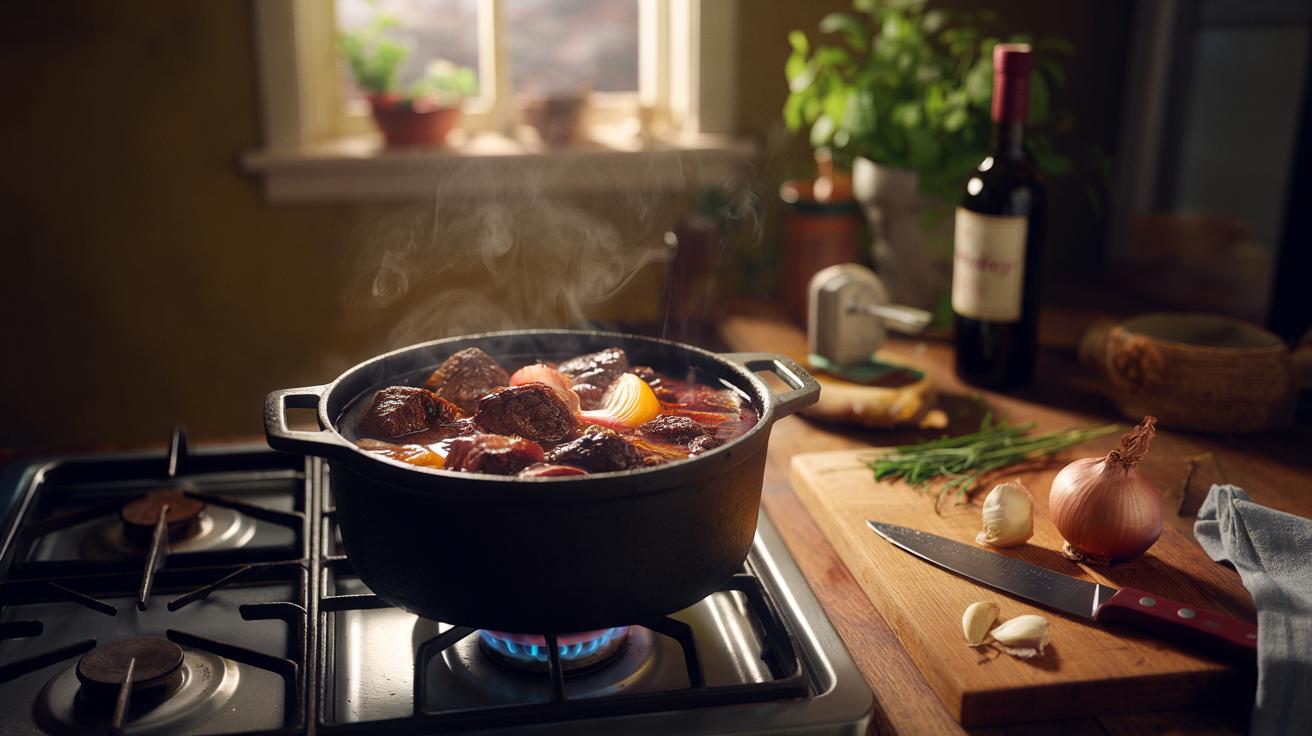
Every cuisine has that one slow dish that draws everyone to the kitchen like a magnet. In my case, it’s a simple braised beef with onions and red wine. On paper, it’s nothing special. Meat, vegetables, liquid, herbs. The kind of recipe you’d scroll past on a busy Tuesday.
But when it cooks slowly for hours, the entire apartment changes. The air thickens, the windows fog a little, someone always pops their head in to ask, “Is that for tonight?” It’s the aroma doing the talking, long before you bring anything to the table.
Rushing it kills that magic before it even starts.
One night I tried to cheat. Same ingredients, same pot, half the time. I cranked up the heat, shortened the browning, reduced the simmer to a violent boil. From the outside, it looked “efficient”, like I’d hacked the recipe.
The meat cooked through, the sauce reduced, the onions softened. Technically, everything was done. Yet when we sat down to eat, there was no depth, no slow-building flavor, no feeling that the dish had gone anywhere. It was food, not comfort.
We’ve all been there, that moment when you realize you saved 45 minutes and lost everything that mattered.
➡️ People who feel emotionally alert at rest often expect interruption
➡️ “I observed my garden early every morning” and spotted stress before damage appeared
➡️ “I felt financially anxious despite earning $72,000 a year”
➡️ This simple cleaning boundary changed how my home feels
➡️ “I stopped cleaning blindly once I learned where dirt really settles”
➡️ This is the easiest way to keep shoes looking new longer
➡️ If you struggle to unwind after screens, this eye-relief trick helps
➡️ If your house never feels fully tidy, this hidden cause is often responsible
What changes during those quiet hours isn’t visible from the outside. The collagen in the meat melts into gelatin, turning tough chunks into silky bites. The sharp edges of the wine soften, onions collapse into sweetness, garlic calms down and slips into the background.
Time does the kind of work no gadget can fake. That’s the plain truth.
When we rush, we skip the part where flavors stop shouting and start talking to each other. The dish can’t relax, and honestly, neither can we. *Slow cooking isn’t only about texture and taste; it’s also about giving yourself permission not to be in a hurry for once.*
How to cook this dish slowly without losing your mind
Here’s the method I use now, whenever I cook this stubborn, wonderful dish. I start earlier than I think I need to. I salt the meat at least 30 minutes in advance, sometimes in the morning if I remember. Then I let it sit while I cut the onions, peel the garlic, and line up the herbs.
I brown the meat in small batches, on a medium heat that feels almost boring. The goal is color, not speed. Then the onions go in, low and patient, until they’re soft enough to mash with the back of a spoon. Only then do I add the liquid: wine first, then stock.
Once it reaches a gentle simmer, the heat goes down. Lid on. Time takes the lead.
The biggest mistake isn’t forgetting a spice or slightly over-salting. It’s fiddling with the pot every five minutes like a nervous DJ. Lifting the lid too often drops the temperature and stretches the cooking time without adding flavor. Stirring aggressively breaks the meat before it’s ready to fall apart on its own.
Another common trap is trying to multi-task with complicated recipes alongside this one. This dish wants background status. Something you check now and then, not babysit. Let’s be honest: nobody really does this every single day.
Reserve it for the evenings when you can afford to let things simmer while life happens around it. Laundry, emails, a shower, a phone call. The pot will wait.
Somebody once told me in a cramped kitchen in Lyon: “Good food forgives mistakes, but it never forgives being rushed.” I didn’t fully get it then. Now this dish reminds me every single time.
- Start earlier than you think — Build in at least an extra hour beyond “done” so you’re not cooking against the clock.
- Brown in small batches — Crowding the pan steams the meat instead of caramelizing it, and that caramelization is where flavor starts.
- Keep the simmer gentle — Tiny bubbles, barely breaking the surface. A rolling boil turns tenderness into stringy disappointment.
- Leave it alone — Lid on, no constant poking. Check every 30–40 minutes, not every 5.
- Use the waiting time well — Set the table, chop herbs, or simply sit down. Let the dish teach you to slow down with it.
Why this one slow dish changes more than dinner
The more I cook this dish, the more it feels like a quiet protest against the way we treat time. Everything around us screams “faster”: deliveries, messages, microwave dinners, 30-minute “miracle” recipes. Then you put a heavy pot on low heat, and suddenly the rules change.
There’s a strange relief in knowing it can’t be rushed. That you can’t tap a button, skip the slow parts, and still get the same result. The dish sets its own pace, and you either match it or you don’t eat as well.
What’s surprising is how quickly this seeps into other parts of life. You start to notice where you’ve been boiling when you should have been simmering. A conversation. A walk. A decision you’ve been trying to fast‑forward.
This isn’t about being some romantic, old‑world cook who spends all day at the stove. Most nights, dinner is quick, practical, perfectly ordinary. But having one dish in your repertoire that demands slowness creates a kind of anchor.
You know you can invite people over and let the smell do half the hosting. You know there’s a recipe that rewards you for starting early, for chopping calmly, for not checking your phone every 30 seconds.
Maybe that’s why people remember these meals. Not just because the meat was tender or the sauce clung just right to the mashed potatoes, but because the evening itself moved differently. Less rush, more presence.
You take a spoonful, and you can taste every minute you didn’t try to save.
| Key point | Detail | Value for the reader |
|---|---|---|
| Slow cooking builds flavor | Low heat over time lets meat, vegetables, and liquids blend and soften | Richer taste and better texture without complicated techniques |
| Process matters more than speed | Browning in batches, gentle simmering, and leaving the lid on | More reliable results and fewer “why is this so bland?” dinners |
| One slow dish changes routine | Anchors your week with a ritual that resists constant rushing | Creates memorable meals and a calmer cooking mindset |
FAQ:
- Question 1How long should a slow-cooked dish like this simmer?
- Answer 1For tough cuts of meat in a braise, around 2.5 to 3 hours at a gentle simmer is a good baseline. Some cuts soften earlier, some benefit from an extra 30–45 minutes. The real test isn’t the clock but the fork: the meat should yield easily without falling into dry shreds.
- Question 2Can I cook it in a slow cooker or Instant Pot?
- Answer 2Yes, with a small adjustment. Brown the meat and onions in a pan first for flavor, then transfer to the slow cooker for 6–8 hours on low, or use the pressure setting on the Instant Pot for around 45–60 minutes. The taste gets close, even if the old‑fashioned stovetop method still wins by a small margin.
- Question 3What cut of meat works best for a slow dish like this?
- Answer 3Look for collagen‑rich, tougher cuts like chuck, blade, shin, or beef cheek. These cuts are cheaper and almost inedible when rushed, but turn melt‑in‑the‑mouth when cooked slowly. Lean steaks dry out and stay stubbornly chewy in this kind of recipe.
- Question 4Can I prepare it the day before?
- Answer 4Absolutely, and it often tastes even better the next day. Let it cool, refrigerate in the same pot if you can, then gently reheat on low. The rest gives flavors time to deepen and meld, and the fat that solidifies on top can be skimmed if you prefer a lighter sauce.
- Question 5What if I don’t have red wine or fancy stock?
- Answer 5Use whatever you have that adds depth: a splash of beer, a bit of soy sauce with water, or even just well‑salted water with a bay leaf and a few garlic cloves. The slow method still works. The time, heat, and patience do more of the heavy lifting than the “perfect” ingredient list.