The hairdresser’s cape rustled as Denise, 63, settled into the chair. She pushed her glasses up, glanced at herself in the mirror and sighed in that way that silently says, “Who is this woman and where did I leave my old face?” Her hair, a grown‑out bob, hung in that awkward zone: too heavy to be soft, too straight to have character, not quite short, not really long.
Her stylist asked the usual question: “So, what are we doing today?”
Denise hesitated. She didn’t want a pixie that erased her softness. She didn’t want long hair that dragged her features down. She wanted movement, lightness, but with a clear outline. A face that still had a frame.
There is one cut that quietly solves exactly that problem.
The haircut that flatters after 60 without erasing your features
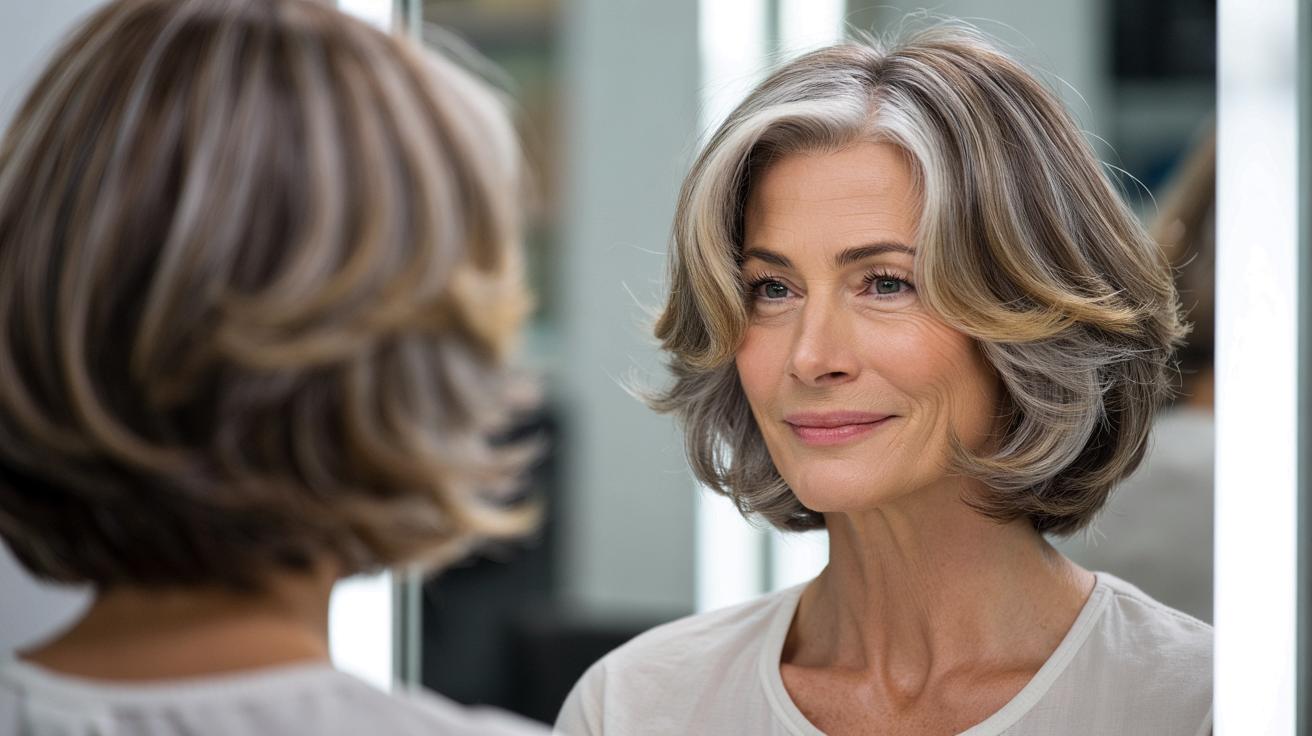
The cut more and more stylists recommend to women over 60 is the **soft layered bob with curtain movement around the face**. Not the stiff, perfectly round bob from the 90s. A looser, airier version, usually between the chin and the collarbones, with subtle layers and slightly opened bangs or side pieces that skim the cheekbones.
Seen from the front, it draws a gentle “C” around the face instead of a hard helmet line. Seen from the side, it breaks that heavy block of hair at the back and replaces it with light, broken edges. It’s the moment when your hair stops fighting your age and starts working with it.
Ask any experienced colorist in a busy salon: the majority of women who cross 60 are asking the same thing. “I want something fresh, but not too short. Softer, but I don’t want to look messy.” A French hairdressing federation survey from 2023 even noted that bobs and mid‑length cuts are the top request for women over 55, ahead of long or ultra‑short styles.
One client I met, Rosa, 68, arrived clinging to her shoulder‑length hair. She left with a collarbone layered bob, a light sweep of fringe, and ten years taken off her posture alone. She didn’t look younger because the cut was trendy; she looked younger because she could see her jawline again.
Why does this cut work so well after 60? Because hair changes texture with age: it thins, loses density, and the ends go wiry faster. Long, blunt hair drags the face down and exposes that thinning. On the other hand, super short crops can sometimes harden features that are already sharper or more hollow.
The layered bob with soft face framing sits in the middle. It keeps a visible outline around the jaw and neck, which gives structure on photos, while broken layers and curtain‑like pieces blur expression lines and soften the middle of the face. *It’s the visual equivalent of switching from harsh overhead light to a warm lamp.*
➡️ Psychology explains why emotional clarity can appear suddenly, without effort
➡️ I cooked this creamy dish and didn’t feel the need to adjust it
➡️ “I stopped cleaning randomly and finally felt in control of my home”
➡️ “I cook this dish slowly because rushing it never works”
➡️ This simple cleaning boundary changed how my home feels
➡️ The budgeting mistake people make after paying off debt
➡️ Psychology explains why emotional responses may appear long after decisions are made
➡️ This is the easiest way to keep shoes looking new longer
How to ask for (and keep) this soft yet structured bob
At the salon, the magic sentence is simple: ask for a bob between chin and collarbone, with soft layering and face‑framing pieces. Bring a photo, but tell your hairdresser what you feel, not just what you see. Say things like, “I don’t want a hard line at the bottom,” or “I like movement around my cheeks.”
If you’re open to it, add a light curtain fringe or longer bangs that split naturally in the middle. That tiny detail changes everything for women over 60: it cuts across a high forehead, diverts the eye from horizontal wrinkles, and spreads volume where hair tends to thin. Your stylist can slide‑cut the ends so the fringe melts into the sides rather than sitting like a block.
The trick at home is not to overstyle. On most days, a gentle blow‑dry with a medium round brush, lifting slightly at the roots and turning the ends in or out just a touch, is enough. Your goal is not a TV‑anchor blowout, but that “I woke up put‑together on purpose” effect.
Let’s be honest: nobody really does this every single day. So the cut has to fall back into place even when you only rough‑dry it with your fingers. That’s why too much layering is a trap. When there are too many short strands, the bob loses its sculpted outline and, two weeks later, you’re fighting those fuzzy pieces around your neck.
One colorist in Lyon told me something that stuck:
“Past 60, haircuts should feel like good lighting, not a costume. You want people to say ‘You look great’, not ‘Nice hair’.”
To keep that subtle effect, a few rules help:
- Keep the length somewhere between the middle of the neck and the top of the shoulders: shorter sharpens, longer drags.
- Ask for “soft layers for movement,” not “lots of layers”: it signals your stylist to respect the bob’s shape.
- Use a light volumizing spray on the roots only, so the outline stays clean while the base lifts.
- Trim every 6–8 weeks to preserve the line before the ends turn brittle or flick out randomly.
- For wavy or curly hair, ask for dry-point cutting on the ends to avoid the triangle effect.
Softness, age, and the right to keep a clear outline
This kind of cut often opens a bigger conversation. At 60, 70, even 80, many women are walking a tightrope between two clichés: the “brave short crop” imposed by time and the long, tired ponytail we keep out of habit. The soft structured bob dodges both boxes. It quietly says, “I’m allowed nuance.”
Some choose to keep their silver hair, others glaze it with champagne beige or warm honey highlights that catch the light on the layers. Some add a slightly shorter nape for a small lifting effect on the neck. What matters is less the exact centimeter of hair and more the feeling when you tilt your head and your hair follows in a light, controlled movement.
| Key point | Detail | Value for the reader |
|---|---|---|
| Soft layered bob | Between chin and collarbone, with movement around the face | Brings lightness without sacrificing a clear, flattering shape |
| Tailored layering | Subtle layers and optional curtain fringe, cut to your texture | Softens lines while keeping structure for photos and everyday life |
| Easy upkeep | Light styling, trims every 6–8 weeks, minimal products | Realistic routine that respects energy, time, and budget |
FAQ:
- Is this cut suitable for very fine hair?Yes, as long as the layers are minimal and the ends are slightly blunt. Too much thinning will make fine hair look stringy, so ask for soft, discreet layering and a clean perimeter line.
- Can I wear a soft bob if I have natural curls?Absolutely. The key is to cut on dry or almost dry hair, shaping the bob with your natural curl pattern and adding longer face‑framing pieces to avoid a bulky triangle shape.
- What if I don’t want any fringe at all?You can skip bangs and still get softness by asking for longer pieces that start around the cheekbones and curve towards the jaw. They frame the face without feeling like a true fringe.
- How often should I go back to the salon?Every 6 to 8 weeks is ideal. That keeps the outline sharp and the layers balanced before the cut grows out into a heavy, boxy shape.
- Does this cut work with fully grey or white hair?Yes, it’s especially beautiful on grey or white hair because the layers catch the light. A gloss treatment can add shine and help your natural color look intentional, not “left as is.”