The notification light was off, the laptop closed, yet Léa’s shoulders still sat like armor around her neck. She lay on the couch, a show playing in the background, fingers hovering near her phone as if someone might need her at any second. The room was quiet, but her mind kept scanning the horizon. Did she answer that email? Did she forget her mother’s message? What if her boss suddenly called with “a quick question” that would swallow the rest of the evening?
On paper, she was resting. On the inside, she was on red alert.
Her body was on the sofa. Her nervous system was in a meeting.
Some people call this anxiety. Others call it being responsible, reactive, “on top of things.” Yet day after day, the same pattern repeats: even in silence, they’re bracing for the next interruption.
And that tension has a story.
Why “doing nothing” feels secretly dangerous
Spend five minutes on a park bench and you can spot them. The people who sit down, sigh, look around…and then instantly reach for their phone, or glance at their smartwatch, or mentally jump to the next task. They’re not bored. They’re on standby, like human fire alarms. Rest doesn’t relax them. Rest exposes how wired they’ve become.
They’ll say they’re “just checking something.” Yet their eyes keep flicking to every vibration, every ping from the street, every child yelling nearby. Their body is still, their attention is sprinting.
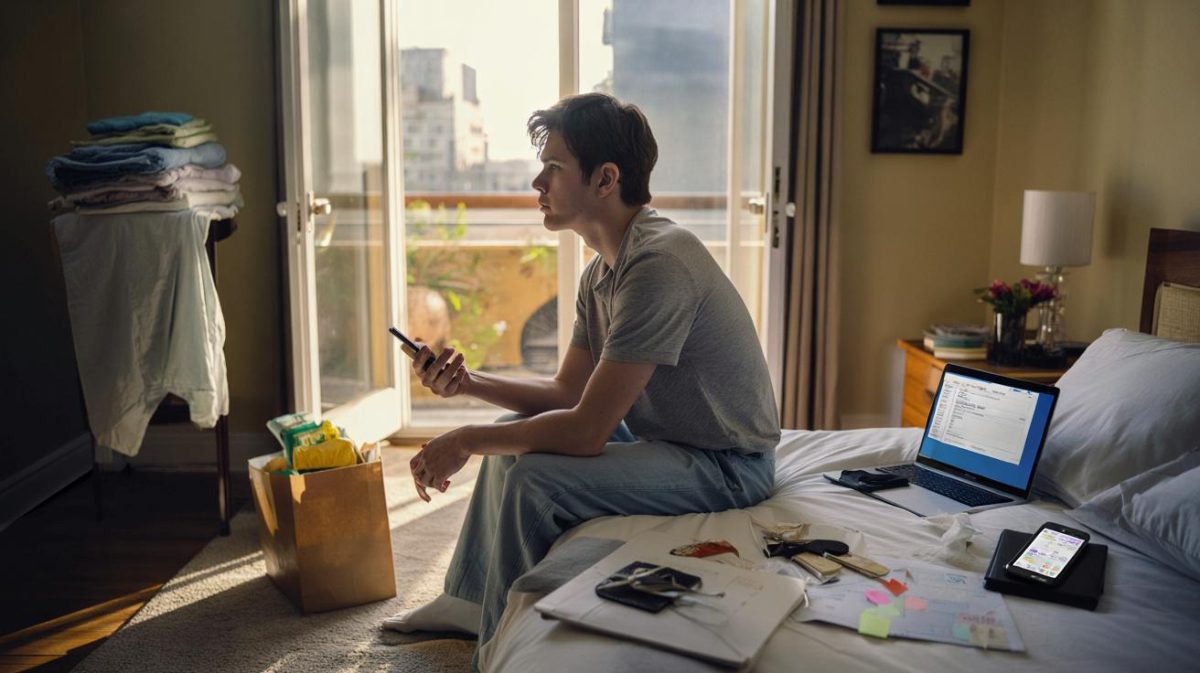
Take Sam. He’s 34, works in tech, and swears he hasn’t had a real weekend in years. He’ll sit on the balcony on Sunday morning with his coffee, trying to “unplug.” Ten minutes later, his mind is hijacked by phantom Slack sounds. He checks his phone even when it’s on silent, then laughs it off. “Just making sure nothing’s on fire.”
When his phone actually rings, he jumps slightly. His muscles were already clenched, as if he’d been waiting for the blow. The call is nothing much. Yet his body doesn’t believe it. His heart keeps pounding for another fifteen minutes.
What’s happening is pretty simple: the brain starts to associate calm with exposure. When you’re resting, you’re not controlling. So your nervous system, trained by years of urgent messages and last-minute demands, whispers: “Stay ready. Something’s coming.” This is learned hypervigilance. The constant expectation of interruption becomes a habit loop. Work emergencies, kids yelling “Mum!”, late-night notifications from friends – over time, they all teach your brain that peace never lasts.
➡️ This habit makes expenses feel justified even when they aren’t necessary
➡️ The subtle impact of mental busyness on physical ease
➡️ “I stopped cleaning randomly and finally felt in control of my home”
➡️ “I stopped cleaning blindly once I learned where dirt really settles”
➡️ Psychology explains why emotional clarity can appear suddenly, without effort
➡️ How to remove pet hair from carpets without special tools
➡️ Why budgets built on optimism rarely survive the year
➡️ This easy oven recipe is one I come back to again and again
So even on the sofa, part of you keeps your shoes on.
Shifting from “on alert” to genuinely off-duty
There’s a small, almost ridiculous exercise that can start to reset this pattern. Pick a five-minute window where you announce to yourself, “For five minutes, nobody gets me.” Put your phone in another room. Turn the sound off on everything. Then sit or lie down, and do nothing except notice what your body does. Maybe your chest tightens. Maybe your mind races to your inbox. Just watch.
After the five minutes, write down one sentence: “During this time, the world did/did not collapse.” Repeat this a few days in a row. You’re not meditating. You’re retraining your brain to see that brief disconnection is survivable.
A common trap is turning rest into another performance. People try to schedule “deep relaxation” like a meeting, then feel guilty if they end up scrolling. Let’s be honest: nobody really does this every single day. The goal isn’t to become a monk of leisure. It’s to gently notice when you’re on emotional alert and dial it down one notch, not ten.
Many of us grew up learning that being available 24/7 meant being a good employee, partner, or parent. So when we say no, or when we truly switch off, shame can creep in. That shame often shows up as fake busyness: tidying a already tidy kitchen, checking the same app again, answering messages that could easily wait.
We’ve all been there, that moment when you finally sit down and your brain pops up with, “You forgot something, get up.”
A psychologist I interviewed summed it up in one sentence: “Your nervous system doesn’t care about your calendar, it cares about your history.”
- Micro-offline rituals – One screen-free moment each day: brushing your teeth, walking to the bus, or making coffee in silence.
- Boundary phrases – Simple lines like “I’ll look at this tomorrow morning” that you repeat out loud when a late message arrives.
- Body check-ins – Noticing three physical sensations (feet on the floor, air on your face, weight of your clothes) to anchor in the present.
- Gentle “no” practice – Once a week, saying no to a non-essential request so your brain learns that declining is safe.
- Repair, not perfection – If you get pulled back into alert mode, you just start again later. No drama, no self-attack.
Living with rest that doesn’t need an alibi
There’s a quiet revolution in learning to rest without earning it, explaining it, or disguising it as “productivity.” Some people start with tiny acts: leaving a message unanswered for an hour, finishing a TV episode without also folding laundry, taking a walk without turning it into a step-counting challenge. The room doesn’t change. The emails don’t magically stop. The shift happens inside, in that subtle moment where you decide not to brace for the next hit.
*Maybe the real skill isn’t time management at all, but nervous-system management.*
The people who once felt constantly on guard begin to notice new signals. A yawn they’d have fought before. A small wave of sadness that surfaces when the noise drops. A thought like, “If I’m not always available, who am I?” That’s the raw material of change, not a sign that something’s wrong.
When we stop expecting interruption at every second, we don’t become lazy or disconnected. We become more deliberate about when we show up and when we step back. And that clarity can be unsettling in a world that profits from our constant attention. Yet it’s contagious too. One person who can genuinely switch off gives silent permission to others: you’re allowed to rest, even if the world keeps ringing.
| Key point | Detail | Value for the reader |
|---|---|---|
| Hypervigilant rest | Feeling on guard even while sitting still or “off work” | Names a hidden form of stress many people silently carry |
| Small disconnection windows | Five-minute “nobody gets me” moments without devices | Offers a realistic way to retrain the brain without overhauling life |
| Body-based cues | Using physical sensations as anchors in calm moments | Gives practical tools to shift from mental alertness to embodied rest |
FAQ:
- Is it normal to feel more anxious when I finally stop?Yes. When external noise drops, internal noise often gets louder at first. Your system is used to distraction. With time, those first waves of anxiety usually soften if you don’t run from them.
- Does this mean I have an anxiety disorder?Not necessarily. Feeling emotionally alert at rest can be a stress response, a personality pattern, or linked to specific life events. If it’s constant or overwhelming, talking to a professional can clarify what’s going on.
- What if my job really expects me to be available all the time?You can still create micro-boundaries: silent modes during meals, clearer response-time expectations with colleagues, or short device-free breaks that don’t clash with your role.
- How long does it take to feel a change?For some, a few weeks of consistent tiny practices already lowers the “always on” feeling. For others, especially with past trauma or burnout, it’s more of a slow, layered process.
- Isn’t being highly responsive a good thing?Responsiveness helps, but not when it costs sleep, health, or basic peace. The goal is choice: being able to turn responsiveness on when it’s needed, and off when it’s not.