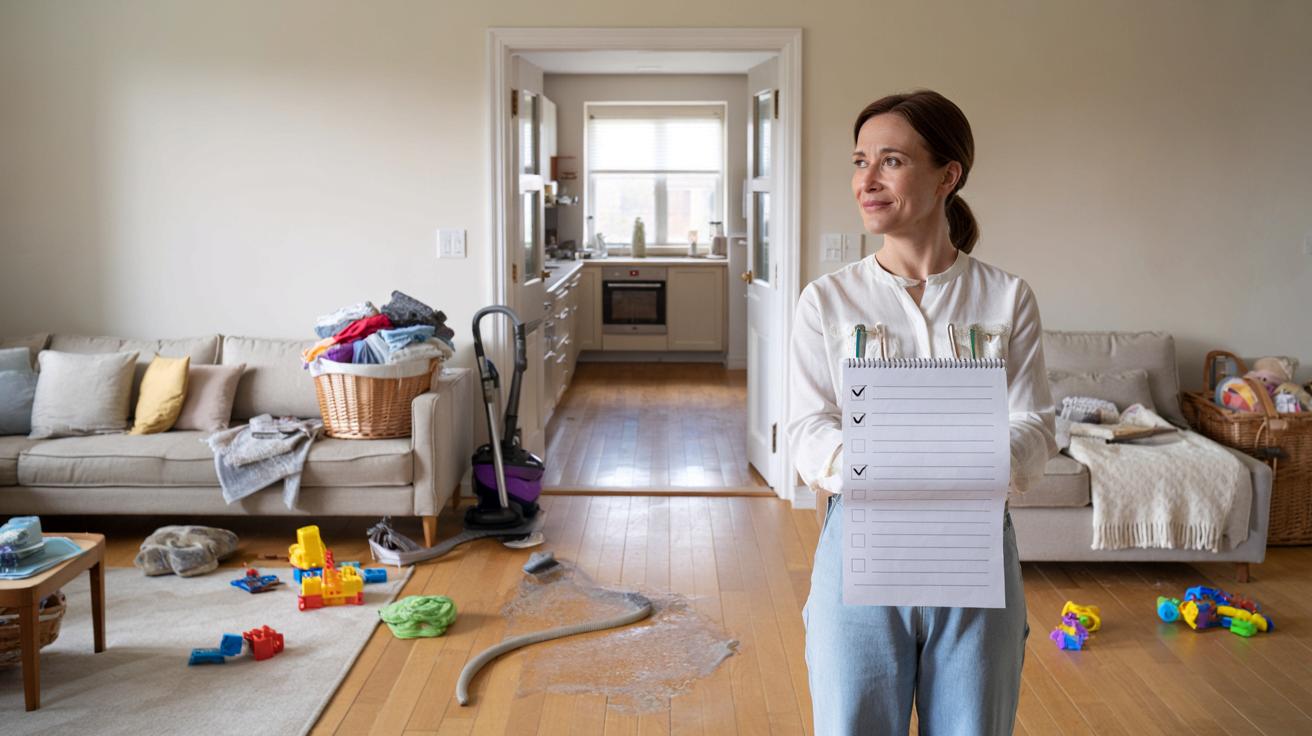
The last time I “cleaned the whole house,” I ended the day on the sofa, staring at a half-folded pile of laundry and a sticky kitchen floor I’d run out of energy to mop.
My phone was full of Pinterest-perfect homes and color-coded schedules. My reality was a vacuum abandoned in the hallway and a silent mental scream every time I stepped on a Lego.
We’ve all been there, that moment when you look around and think, “How is this still messy when I’ve been cleaning all day?”
One Sunday, defeated and slightly angry at my own house, I realized the real problem.
I wasn’t lazy.
I was cleaning randomly.
That day, everything quietly shifted.
When “cleaning all the time” never feels like enough
My old cleaning style was pure chaos.
I’d start wiping crumbs in the kitchen, notice the stack of mail, carry the mail to the living room, see dust on the TV, go grab a cloth, then remember the bathroom sink… and so on.
By midday, I’d touched every room and finished none.
I felt busy, exhausted, and permanently behind.
The house wasn’t exactly dirty, just cluttered and unsettled, like it was in a constant state of “almost there.”
That constant low-level mess?
It eats at your brain.
One morning, my daughter asked, “Why are you always cleaning if the house is always messy?”
She didn’t mean it badly.
She was just saying what I’d been feeling for months.
I started timing myself without changing anything, just observing.
Ten minutes wiping the counter.
Sixteen on dishes.
Nine scrolling my phone “for a break” between loads of laundry.
By the end of the day, I had spent more than two hours “cleaning” in scattered bursts.
Yet there were still toys on the stairs, laundry on chairs, and that same sticky spot by the fridge.
Random effort, random result.
➡️ This easy oven recipe is one I come back to again and again
➡️ This creamy one-dish meal is ideal when you don’t want leftovers piling up
➡️ “I stopped cleaning blindly once I learned where dirt really settles”
➡️ The subtle impact of mental busyness on physical ease
➡️ Feeling emotionally “on call” all the time has a clear psychological origin
➡️ This overlooked routine explains why weekends feel exhausting
➡️ The budgeting mistake people make after paying off debt
➡️ People who feel emotionally alert at rest often expect interruption
The real problem was mental, not mechanical.
My brain was in emergency mode all the time, jumping from one visual annoyance to the next.
Every sock on the floor felt urgent.
Every crumb felt like a personal failure.
There was no rhythm, no clear idea of “what gets done when.”
So I trusted my mood, my energy, and my guilt to tell me what to do.
Spoiler: they’re terrible managers.
*Once I understood that I didn’t need to clean more, I just needed to stop cleaning randomly, the entire house felt different in my head before it even looked different in real life.*
The day I swapped chaos for a quiet, boring rhythm
I didn’t create a complicated system.
I picked one simple rule: each day has its job.
Mondays: bathrooms.
Tuesdays: dust and surfaces.
Wednesdays: floors.
Thursdays: laundry focus.
Fridays: kitchen deep-ish reset.
Every day also got a tiny “baseline” list: 10-minute tidy, dishes done, counters cleared.
Nothing dramatic, nothing Instagram-worthy.
Just a repeatable rhythm I could follow even while tired or grumpy.
The key was this: if something wasn’t on that day’s job or the daily baseline, I let it go.
At first, letting go felt wrong.
I would see smudges on the mirror on a Wednesday and feel that familiar itch to grab the spray.
Still, I’d remind myself: “Mirrors are Monday’s problem.”
One small story: I used to deep-clean the whole bathroom “whenever it looked bad.”
That meant I always waited until it was borderline gross, then spent an hour scrubbing.
Now, Monday’s bathroom routine takes about 20 minutes: sink, toilet, quick wipe of the shower, change towels, empty trash.
The mirror might not sparkle every day, yet it never gets disgusting.
The job is boringly manageable instead of emotionally loaded and overwhelming.
Let’s be honest: nobody really does this every single day.
The reason this works is simple.
Your brain loves predictability.
When your home has a schedule, decisions shrink.
You’re not asking, “What should I clean?” all the time.
You’re asking, “What’s today’s thing?”
Random cleaning is like opening 20 browser tabs and trying to read them all at once.
A steady routine is one tab at a time.
Oddly enough, once I knew what I wasn’t doing each day, I felt lighter.
Everything had a place in time, not just a place in the room.
How to stop cleaning randomly (without turning into a robot)
If you want that feeling of control, start tiny.
Grab a piece of paper and divide your week into seven days.
Write one focus per day.
Keep it embarrassingly simple:
Floors, laundry, bathroom, kitchen, surfaces, bedrooms, “catch-up.”
Then choose a micro baseline:
5–15 minutes of daily reset where you pick up obvious clutter, do the dishes, and clear one main surface.
The goal isn’t a spotless home.
The goal is a home that never feels like a surprise disaster.
Here’s where most of us stumble: we try to do all the things, every day, from the start.
We create a beautiful chart, follow it for three days, miss one, and declare ourselves failures.
Be kinder than that.
Your routine is there to serve you, not the other way around.
If you miss “bathroom day,” move it, shorten it, or skip it this week.
Nothing tragic happens if the shower waits three more days.
The real win is staying in the rhythm overall, not sticking to it perfectly.
And if you live with other humans, involve them in the smallest possible way.
One task, one room, one drawer.
Small is sustainable.
On the day my house finally started to feel calm, I wrote one sentence in my notebook and underlined it twice:
“I don’t need a perfect home, I need a predictable home.”
That became my quiet rule.
To keep it practical, I keep a short list on the fridge:
- Daily: dishes, 10-minute tidy, clear the main table
- Monday: bathrooms (20 minutes)
- Tuesday: dust + wipe main surfaces (15 minutes)
- Wednesday: vacuum or sweep floors (25 minutes)
- Thursday: laundry focus (wash, dry, put away one full cycle)
- Friday: kitchen reset (fridge quick check, counters, sink)
- Weekend: flexible catch-up or pure rest
That little list is not glamorous.
Yet it’s the reason my home no longer feels like an emergency.
Living in a house that finally feels “held”
Something subtle shifts when your home stops relying on panic-cleaning and random bursts of energy.
You stop negotiating with yourself all the time.
You stop walking into rooms and mentally attacking everything you see.
There’s more room for real life: messy art projects on the table, half-read books on the sofa, the occasional crumbs that mean people actually live there.
You can invite a friend over without needing a four-hour “operation clean-up.”
The funny thing is, my house isn’t dramatically tidier than the homes you see online.
The real change is inside my head.
The mess no longer feels like a personal failing.
It feels like something I know how to handle, one day and one small job at a time.
Maybe that’s what control really is at home.
Not perfection.
Just a steady, human rhythm that quietly holds you up.
| Key point | Detail | Value for the reader |
|---|---|---|
| Stop random cleaning | Replace scattered efforts with one clear focus per day | Reduces mental overload and decision fatigue |
| Create a simple weekly rhythm | Assign basic tasks to specific days and keep a tiny daily baseline | Makes cleaning predictable and easier to maintain long term |
| Accept “good enough” | Let non-urgent mess wait for its scheduled time | Lowers guilt and helps you feel genuinely in control of your home |
FAQ:
- Question 1What if my schedule changes every week?
- Answer 1Pick floating “slots” instead of fixed days. For example, aim for three bathroom sessions and two floor sessions per week, and plug them into your calendar as you go. The rhythm matters more than the exact day.
- Question 2How long should daily cleaning take?
- Answer 2For most people, 15–30 minutes of daily baseline plus one small focused task is enough to stay afloat. If your home is very cluttered right now, it may take more at first, then naturally shrink over time.
- Question 3What if I’m naturally messy and hate routines?
- Answer 3Start with the absolute minimum: one 10-minute reset at the same time each day. Once that feels normal, add just one weekly focus (for example, bathroom day). Keep the system as light as your personality needs.
- Question 4How do I get my family to help?
- Answer 4Give each person one tiny, clear, repeatable job: taking out the trash, clearing the table, putting dirty clothes in hampers. Clarity works better than vague “help more” requests, especially with kids and tired partners.
- Question 5What about deep cleaning like windows and closets?
- Answer 5Once your weekly rhythm feels stable, add a monthly “deep-dive” slot. Each month, pick just one area: windows, a closet, the oven. Rotate through them slowly instead of trying to conquer everything in a single weekend.